
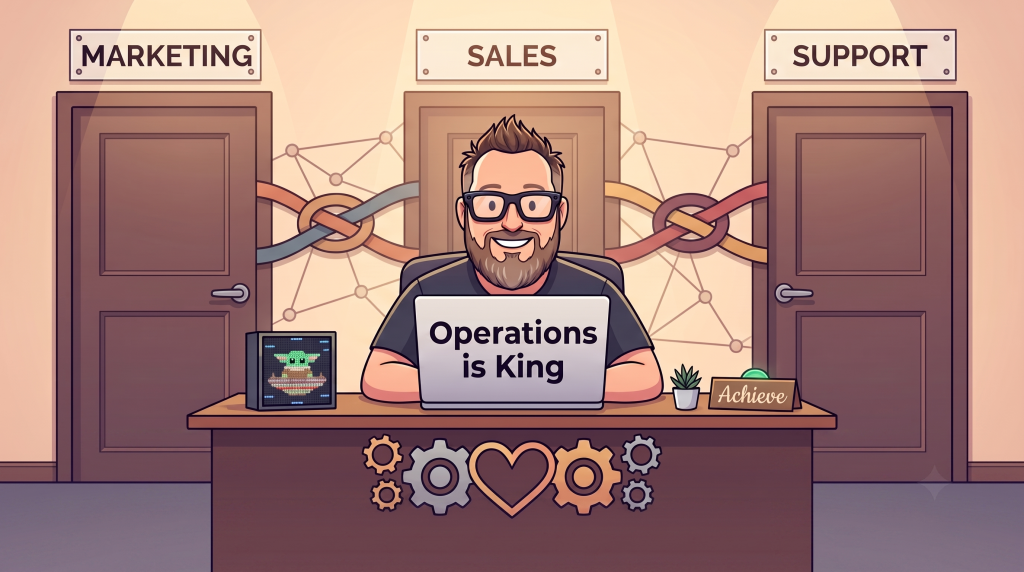
I have worked in sales, marketing, and support for a long time. More recently, my focus has been in operations, the glue that holds everything together. Based on my experience and observations, I know that more and more organizations need to improve the relationship and communications between the teams for better overall results.
We have all been there. You see a fantastic ad on social media or get a perfectly timed email in your inbox. The branding is beautiful, the copy is witty, and the offer is exactly what you need.
You click “buy now”, because you were completely hooked.
Then, the wheels fall off.
Your order takes three weeks to ship without a single tracking update. When it finally arrives, it is the wrong size. Or maybe you sign up for a saas product that promises the world, but in reality, it does not live up to expectations and is hard to use.
You reach out to customer support, only to get stuck in a robotic chat loop that leads nowhere. And by the way, this is happening more and more!
What happened? Marketing did its job beautifully. It attracted you, and it converted you. But operations was left in the dark, and as a result, the business just lost a customer for life.
Marketing and operations are often treated like two entirely different worlds. Marketing is seen as the creative, creative department that brings people through the door. Operations is viewed as the quiet, behind-the-scenes engine handling logistics, data, fulfillment, and support. But if you want to attract, convert, and retain customers over the long haul, these two departments cannot run on separate tracks. They have to team up and be best friends.
Attracting the Right Crowd
Marketing and sales are fantastic at generating demand. They know how to build brand awareness, run paid ads, and create email campaigns that get people engaged. But marketing can only promise what operations can actually deliver.
When marketing and operations do not communicate, marketing might push a massive campaign for a product or serves that operations knows is backordered for a month or does not have the best UI or certain features have unresolved bugs. Or worse, marketing targets an audience that looks great on paper but is a nightmare for operations to onboard or support.
But, when these teams align, marketing can run campaigns based on real-time inventory, capacity, customer experience. If operations have optimized production and logistics, it keeps the cost of goods sold down. It helps retain customers, increasing ARR (average recurring revenue). That healthy profit margin gives marketing the room to design competitive, profitable promotions that actually drive revenue, not just vanity metrics.
Converting with Zero Friction
Conversion is not just about having a pretty landing page, though you know I love a well-designed landing page that gets to the point. Conversion is about reducing friction and anxiety for the buyer. If a prospect wants to buy but your backend system, UI, or has numerous steps, it makes it complicated, and they are going to bounce off your website (leave).
Operations is responsible for the actual fulfillment and the infrastructure behind the scenes, including the software and logistics that support a sale. If your checkout process is clunky, your contract delivery is delayed, or your sales enablement tools are broken, the conversion falls apart right at the finish line.
To get those conversions over the line, operations needs to ensure the sales and marketing teams have the correct inventory data, smooth digital contract or conversion processes, and seamless CRM integrations. When the technical side matches the marketing promise, the customer transitions from prospect to buyer without a single bump in the road.
Retaining for Lifelong Value
Acquiring a customer is only the first step. The real profit happens when that customer stays (ARR), buys again, and tells their friends or network. Marketing can send all the winback email campaigns and newsletter perks it wants, but retention lives and dies in the post-sale experience.
Operations manages the post-sale customer experience, the shipping times, the technical support, and the account management. If a customer has a seamless experience with fulfillment and support, you build massive brand loyalty. That operational excellence drives positive reviews and skyrockets your customer lifetime value.
Marketing can then take those glowing reviews and use them as social proof for the next campaign. It is a perfect, continuous loop.
The Data Bridge
How do we make sure this partnership actually works? It all comes down to data alignment and constant communication. Operations typically manages the CRM and enterprise resource planning systems. Marketing manages the front-end engagement tools.
By aligning this data, both teams can accurately track the true customer journey, look at the sales funnel to identify exactly where people are dropping off, and accurately forecast future demand. Marketing gets to see which campaigns lead to the highest customer satisfaction or conversion, and operations gets a heads-up on when a massive wave of new customers is about to head their way.
Stop letting your departments run in silos. Grab a coffee (virtual or in person) with your operations or marketing counterpart this week and look at where your customer journey has friction.
How does your organization bridge the gap between marketing promises and operational reality?